

Gypsum Board False Ceiling: Complete Material Guide
A gypsum board false ceiling is a suspended ceiling system made from gypsum plasterboard fixed to a supporting metal framework. It is widely used in residential interiors because it can create a clean, seamless ceiling while accommodating recessed lighting, concealed wiring and different design profiles. But the board itself is only one part of the system. The frame, suspension, joints, finishing and the type of board selected for the room all affect the final result.
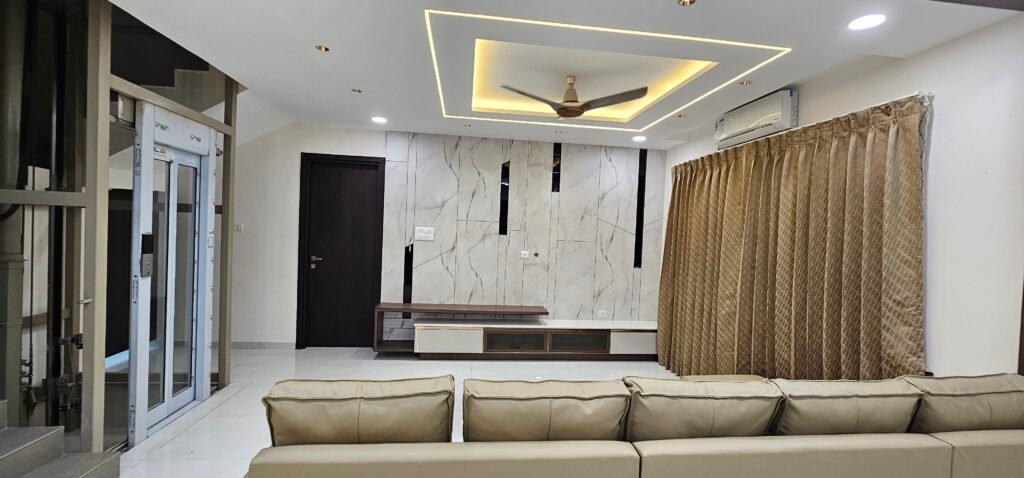
What is a gypsum board false ceiling?
A gypsum board false ceiling consists of gypsum plasterboard fixed to a metal framework below the structural slab.
The visible surface is the gypsum board. Behind it is the supporting framework and the space required for electrical wiring, lighting, air-conditioning services and other concealed requirements.
Once the boards are fixed, the joints and screw points are treated before the surface is finished and painted.
This construction allows designers to create both simple flat ceilings and more detailed forms such as:
- Perimeter recesses
- Cove lighting
- Recessed panels
- Layered ceiling details
- Linear lighting channels
- Curved or shaped features
- Lighting pockets
The important point is that a gypsum false ceiling is a system, not simply a sheet attached to the ceiling.
What materials are used in a gypsum board false ceiling?
A properly executed gypsum board ceiling normally involves several components working together.
1. Gypsum board
This forms the visible ceiling surface.
Different boards are available for different performance requirements. A standard board may be appropriate for a normal dry room, while moisture-resistant or fire-resistant boards can be selected where the conditions require them.
The board should therefore be selected according to the room and the required performance rather than simply choosing the same board throughout the house.
2. Metal framework
The framework provides the structural support for the ceiling.
It typically includes ceiling sections, channels, perimeter components and suspension-related elements. The exact configuration depends on the ceiling system and site requirements.
This part is easy to overlook because it disappears once the ceiling is finished, but it has a major effect on the stability and long-term performance of the ceiling.
3. Screws and fasteners
The gypsum boards are mechanically fixed to the framework using suitable screws.
The fixing pattern and fastener selection should follow the requirements of the chosen ceiling system.
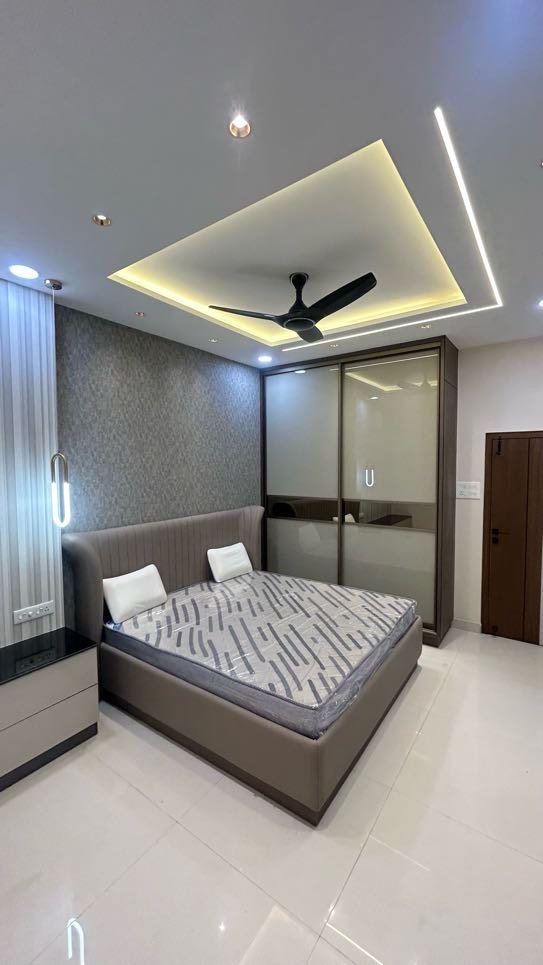
4. Jointing materials
The gaps between boards need to be properly treated.
Jointing compounds and reinforcement tape are used to create a continuous surface before painting.
Poor joint treatment is one reason a new ceiling can develop visible lines or cracks after finishing.
5. Finishing materials
After the joints are treated and the surface is prepared, the ceiling can receive the required paint finish.
The quality of preparation matters as much as the final paint. A smooth gypsum ceiling will show surface imperfections clearly, particularly under strong downlights or concealed lighting.
What types of gypsum board are used for false ceilings?
There is no single gypsum board that is automatically right for every room.
Standard gypsum board
Standard gypsum board is generally intended for normal dry interior applications.
It works well for many living rooms, bedrooms, passages and other areas where moisture exposure is not a major concern.
For a conventional residential ceiling, this can be the starting point.
Moisture-resistant gypsum board
Moisture-resistant boards are designed for areas where the ceiling may experience higher moisture exposure.
Depending on the product and system, they can be considered for spaces such as kitchens and bathrooms.
This does not mean that moisture-resistant board makes a ceiling waterproof. The source of moisture still needs to be controlled through ventilation, plumbing, waterproofing and proper construction.
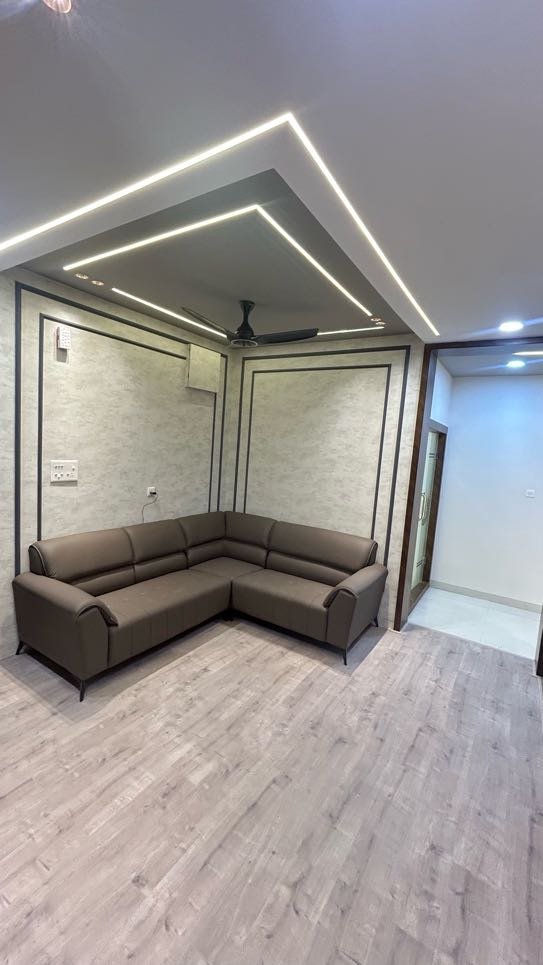
Fire-resistant gypsum board
Fire-resistant boards are designed for applications where increased fire resistance is required.
However, one important distinction should not be missed: the fire rating belongs to the tested ceiling system, not simply to a piece of gypsum board.
The board, framing, fixing and other components need to form the appropriate tested system for the claimed performance.
That is why a contractor should not promise a particular fire-resistance period merely because a fire-rated board has been used.
Other specialist boards
Gypsum manufacturers also offer boards designed for particular performance requirements, including moisture, acoustic or impact-related applications.
The right specification depends on the room, building conditions and intended performance.
Why is gypsum board popular for false ceilings?
Gypsum board gives designers considerable flexibility.
A flat ceiling can remain visually quiet, while the same material can also be shaped into more detailed architectural features.
Some of its practical advantages include:
- Smooth, continuous appearance
- Compatibility with recessed lighting
- Flexibility in ceiling design
- Ability to conceal wiring and services
- Suitable substrate for paint finishes
- Clean integration with contemporary interiors
- Ability to create different levels and profiles
This makes gypsum particularly useful when the ceiling needs to support both design and functional requirements.
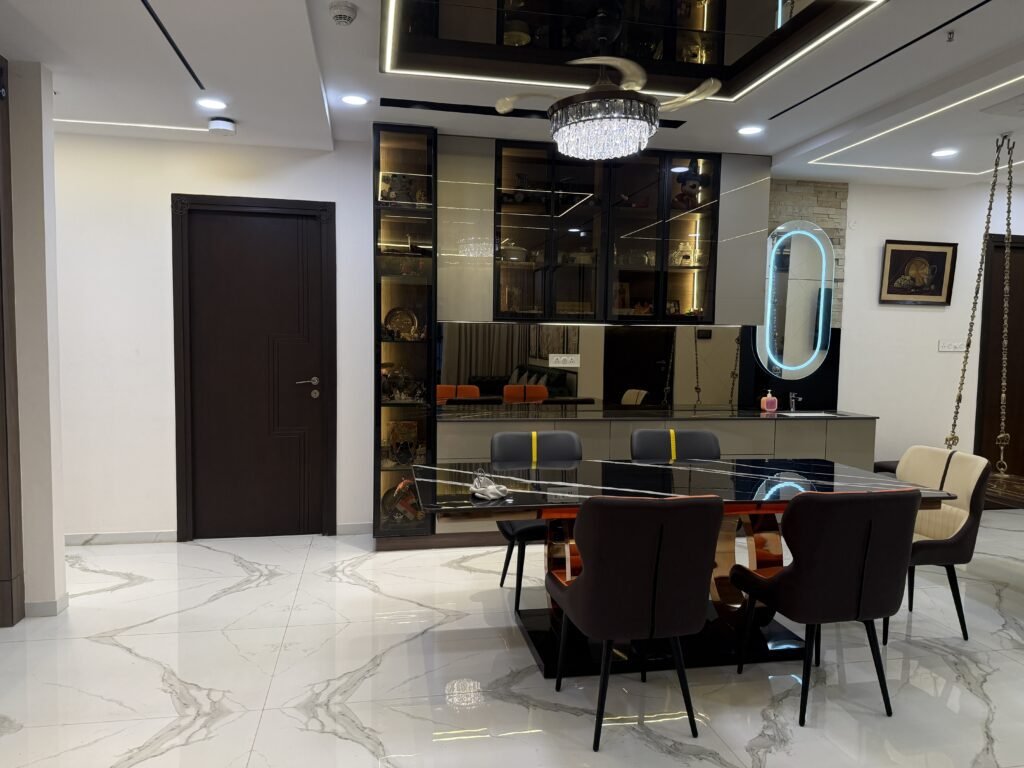
How should you choose gypsum board for different rooms?
The same specification does not necessarily make sense throughout a home.
Room | What to consider |
Living room | Design, lighting, ceiling height and overall finish |
Bedroom | Simple detailing, lighting and furniture coordination |
Dining area | Lighting position and relationship with the dining layout |
Kitchen | Moisture exposure, services, cabinets and ventilation |
Bathroom | Moisture conditions and appropriate board/system |
Passage | Simple profiles and practical lighting |
Utility area | Moisture and service requirements |
For kitchens in particular, the ceiling should be coordinated with the modular kitchen rather than designed independently. Decore Designz’s interior service approach similarly treats kitchen layout, storage, appliances, lighting, electrical points and finishes as connected planning decisions.
Can gypsum board be used for kitchen false ceilings?
Yes, but the board and ceiling system should be selected according to the kitchen’s conditions.
A kitchen has electrical points, lighting, cabinets, ventilation and other services that need to work together.
That means the question should not simply be “Can I use gypsum here?”
It should be:
What board, framing, detailing and ventilation approach is appropriate for this kitchen?
A moisture-resistant solution may be relevant where conditions require it, while areas exposed to direct water or persistent moisture need more careful specification.
For a complete kitchen interior, the ceiling should also be coordinated with the modular kitchen layout and services.
How does gypsum compare with other false ceiling materials?
Gypsum should not be selected simply because it is currently popular.
Other ceiling materials have their own characteristics, and the right choice depends on the room and the desired performance.
The deeper POP vs Gypsum vs PVC comparison should be treated separately because it involves different considerations such as moisture resistance, flexibility, durability and design requirements.
For a gypsum-specific decision, start with these questions:
- Is the room predominantly dry?
- Is moisture exposure expected?
- How much ceiling height is available?
- What lighting needs to be concealed?
- Are there services that need access later?
- How complex is the proposed design?
- What finish is required?
This gives you a more useful answer than selecting a material based only on appearance.
What makes a gypsum false ceiling last longer?
Good material selection is only one part of the result.
Execution quality matters.
Pay attention to:
- Proper metal framing
- Correct board selection
- Appropriate fixing
- Proper joint treatment
- Controlled moisture
- Accurate service coordination
- Suitable lighting installation
- Good surface preparation
- Proper finishing
A premium-looking ceiling is not created by the board alone.
The structure behind it and the workmanship during installation matter just as much.
What are the most common gypsum false ceiling mistakes?
Using standard board where moisture is a concern
Board selection should follow the room conditions.
Treating the frame as an invisible afterthought
The framework supports the finished ceiling and should not be compromised simply because it will eventually be hidden.
Designing the ceiling before the furniture
The ceiling, lighting and furniture layout should work together.
Adding too many levels
More detailing creates more execution complexity and can make a room feel visually heavy.
Forgetting maintenance access
Lights, wiring, air-conditioning and other concealed services may eventually require attention.
Assuming every room needs the same ceiling
Different rooms have different functional requirements.
Decore Designz’s existing false-ceiling guidance makes the same broader point: not every room in an apartment necessarily needs the same ceiling treatment. The decision should follow the room’s lighting, services, height and use.
Does every home need a gypsum false ceiling?
No.
A gypsum false ceiling is useful when it solves a design or functional requirement.
It can help conceal services, organise lighting and create a cleaner architectural finish. But if a room already works well with its original slab and there is no meaningful reason to lower the ceiling, adding a false ceiling simply for decoration may not be necessary.
This is particularly important in apartments where available ceiling height is limited.
A practical way to choose a gypsum false ceiling
Before finalising the design, work through this checklist:
Room: What is the room used for?
Height: How much ceiling height can be given up?
Services: What needs to run above the ceiling?
Lighting: Where should ambient, task and accent lighting go?
Moisture: Is the room dry, humid or exposed to water?
Board: Does the selected board match the conditions?
Frame: Is the supporting system appropriate?
Design: Does the ceiling complement the furniture and walls?
Maintenance: Can important services be accessed later?
Finish: Has enough attention been given to joints, preparation and painting?
These questions usually produce a better ceiling than starting with a photograph of a decorative design and trying to reproduce it.
Final thoughts
A gypsum board false ceiling should be treated as a complete construction system rather than simply a decorative sheet on the ceiling.
The right board matters. So does the metal framework, fixing, joint treatment, lighting coordination and final finishing. Most importantly, the specification should match the room.
For a Hyderabad home, Decore Designz Studio approaches false ceiling decisions as part of the wider interior rather than as an isolated design element. The ceiling can be coordinated with lighting, furniture, kitchen planning, wardrobes, electrical requirements and the overall execution of the home.
If you are planning a new interior, you can explore Decore Designz Studio’s [interior design services in Hyderabad] and discuss the appropriate ceiling system as part of the complete design and execution plan.
Frequently Asked Questions
What is a gypsum board false ceiling?
It is a suspended ceiling system in which gypsum plasterboard is fixed to a supporting metal framework below the structural slab. The finished surface can be painted and shaped into different ceiling designs.
Is gypsum board good for false ceilings?
Gypsum board is a versatile option for false ceilings because it provides a smooth finished surface and can accommodate different profiles, recessed lighting and concealed services. The appropriate board and system depend on the room conditions.
Is gypsum board waterproof?
Standard gypsum board should not be treated as waterproof. Specialist moisture- or water-resistant boards are available for conditions where increased moisture resistance is required.
Which gypsum board is best for a kitchen ceiling?
The appropriate board depends on the kitchen’s moisture conditions and the complete ceiling system. A moisture-resistant specification may be appropriate where required, but ventilation and moisture control remain important.
Is gypsum board fire resistant?
Gypsum has fire-resistant properties, but the fire-resistance performance of a ceiling depends on the complete tested system. The board should not be treated as providing a particular fire rating on its own.
Can gypsum false ceilings be repaired?
Yes. Damaged sections can generally be repaired or replaced, followed by joint treatment, surface preparation and repainting. Access requirements should be considered during the original design.
How long does a gypsum false ceiling last?
Its service life depends on the quality of the board, framing, installation, environmental conditions and maintenance. Moisture problems, poor framing and inadequate finishing can affect performance.
Can gypsum false ceilings have LED lights?
Yes. Gypsum board ceilings are commonly designed around recessed lights, LED strips, cove lighting and other fixtures. The lighting layout should be planned before the ceiling is constructed.