

False Ceiling in a Balcony: Does It Make Sense?
A false ceiling in a balcony can work, but it is not automatically a good idea. Unlike a living room or bedroom, a balcony may be exposed to rain, humidity, dust, heat and changing outdoor conditions. The decision should therefore start with one question: is the balcony sufficiently protected for the ceiling material and construction to remain practical over time?
For a fully enclosed or well-protected balcony, a carefully planned ceiling can improve lighting and give the space a more finished appearance. For an exposed balcony, skipping the false ceiling may be the more sensible decision.

Is a false ceiling good for a balcony?
It depends on how exposed the balcony is.
A false ceiling can make sense when the balcony is enclosed by glazing, protected by a substantial slab above, or otherwise shielded from direct rain and excessive moisture. It can provide a place for lighting, conceal wiring and visually connect the balcony with the adjoining interior.
But if rain can regularly reach the ceiling, the material, framing, joints, electrical fittings and finishes need to be considered much more carefully.
A decorative ceiling is not useful if it creates a maintenance problem a few months later.
When does a balcony false ceiling make sense?
The strongest case is usually a covered, protected balcony that functions as an extension of the home.
For example, a balcony may be used as:
- A small seating area
- A reading corner
- A morning coffee space
- A compact garden
- An extension of the living room
- A utility or multipurpose area
When the balcony is being used as an actual living space rather than simply as an open outdoor platform, a ceiling treatment may help integrate it with the rest of the interior.
The design still needs to respond to the exposure level.
When should you avoid a false ceiling in a balcony?
There are several situations where adding one may create more problems than benefits.
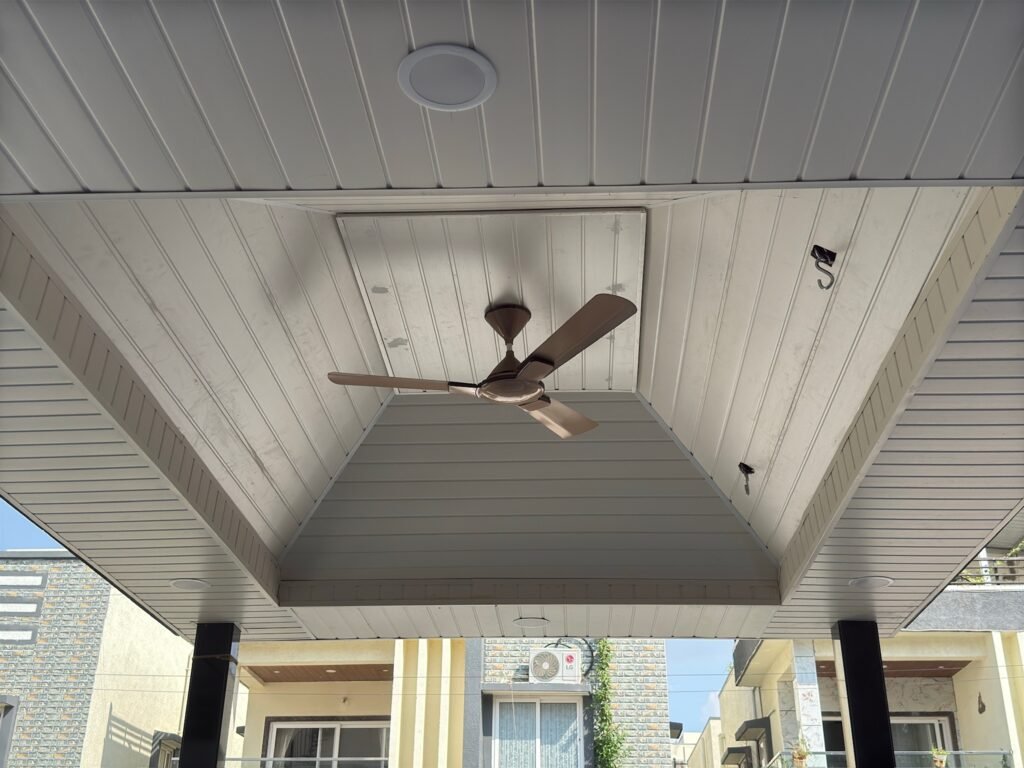
1. The balcony is directly exposed to rain
This is the biggest concern.
If wind-driven rain regularly reaches the ceiling, moisture can affect unsuitable ceiling boards, finishes, joints and electrical components.
In this situation, a decorative false ceiling should not be treated like an indoor living-room ceiling.
2. The balcony has persistent dampness
If the slab, walls or surrounding surfaces already show signs of dampness, seepage or water staining, adding a false ceiling does not solve the underlying problem.
The source of moisture should be addressed first.
Covering a problem with a new ceiling can simply make future inspection and repair more difficult.
3. The balcony has very limited height
A balcony is often narrower than the rooms inside the home.
If the existing ceiling is already low, a false ceiling can make the space feel compressed.
A painted structural ceiling with appropriate lighting may be more effective than lowering it further.
4. The balcony is mainly a utility space
If the balcony is primarily used for drying clothes, storing items or housing utility equipment, there may be little reason to introduce a decorative false ceiling.
The design should follow the actual use of the space.
What should you check before installing a false ceiling in a balcony?
Before selecting a design, check the balcony itself.
How much rain reaches the ceiling?
Do not judge this only from the balcony’s appearance on a dry day.
Consider the direction of rain, wind exposure, the depth of the slab above and whether water can reach the ceiling during heavy weather.
Is the balcony open, semi-enclosed or enclosed?
This distinction matters.
Balcony condition | False ceiling consideration |
Fully exposed | Usually requires strong justification and suitable materials |
Partially covered | Assess rain and moisture exposure carefully |
Glazed/enclosed | More practical if ventilation and moisture are controlled |
Deeply covered balcony | Can be suitable with appropriate material selection |
Balcony with existing dampness | Resolve moisture issues first |
There is no universal material that makes every outdoor ceiling suitable. The actual site condition matters more than the name of the material.
Which materials can be considered for a balcony ceiling?
Material selection becomes more important as exposure increases.
Gypsum board
Gypsum is widely used for interior false ceilings because it allows clean profiles and integrated lighting.
However, a balcony exposed to moisture should not simply be treated like a dry bedroom or living room. The specific board, framing, finishing system and site exposure need to be assessed before choosing it.
For a fully protected balcony, gypsum may be considered as part of the overall design where site conditions support it.
PVC panels
PVC can be considered where moisture exposure is a significant concern, but that does not mean every PVC ceiling is automatically suitable for every balcony.
The quality of the system, supporting structure, joints, ventilation and exposure conditions still matter.
Exterior-suitable ceiling systems
For more exposed applications, the designer should consider systems specifically appropriate for the environmental conditions rather than simply selecting an indoor false-ceiling material.
The important point is to specify the complete system, not just the visible panel.
The frame, fixings, joints, finish and electrical components all form part of the ceiling.
Does a balcony need a waterproof false ceiling?
A false ceiling should not be used as a substitute for waterproofing.
If water is entering through the slab or surrounding construction, the waterproofing or drainage problem needs to be addressed at its source.
A ceiling installed underneath a leaking structure may hide the visible symptoms while making the actual problem harder to identify.
This is particularly important in balconies because they are more exposed to weather than internal rooms.
Can you use a gypsum false ceiling in a balcony?
You can consider gypsum in a sufficiently protected balcony, but exposure needs to be evaluated first.
A common mistake is assuming that because gypsum works well in a living room, it will automatically work in an outdoor-facing balcony.
The correct sequence is:
check exposure → check moisture → check ceiling height → decide whether a false ceiling is actually needed → select the appropriate system → plan lighting and finishing.
The material should come after the site assessment, not before it.
What lighting works with a balcony false ceiling?
Lighting is one of the strongest reasons to consider a ceiling treatment in a protected balcony.
A simple ceiling can accommodate:
- Recessed lights
- Concealed LED lighting
- Small surface-mounted fixtures
- Wall lighting
- Decorative pendant lighting where appropriate
But outdoor-facing areas need suitable electrical fittings and installation practices for their environmental exposure.
Do not assume that an indoor lighting fixture is appropriate simply because it looks good in a balcony photograph.
The lighting should also support how the balcony is used.
A reading corner may need focused light. A seating area may benefit from softer ambient illumination. A plant-heavy balcony may need a different lighting arrangement altogether.
Should the false ceiling match the living room?
Usually, some visual connection helps.
If the balcony opens directly from the living room, carrying a similar colour palette, ceiling line or material language into the balcony can make the two spaces feel connected.
That does not mean copying the living-room ceiling exactly.
A balcony has different environmental conditions and a different purpose. The ceiling can be simpler while still relating to the interior.
For example, if the living room uses a restrained gypsum ceiling with warm lighting, the balcony could use a simpler ceiling treatment and complementary lighting rather than reproducing the entire interior ceiling design.
This broader approach is consistent with Decore Designz Studio’s residential design philosophy: lighting, materials, furniture and spatial planning are considered together rather than designing one element in isolation. Its Hyderabad residential services include living-room planning, lighting, materials and ceiling concepts as part of the wider interior scope.
What are the best false ceiling designs for a balcony?
A balcony generally benefits from restraint.
1. Simple flat ceiling
If the balcony is well protected, a clean single-level ceiling can provide a finished appearance without making the space visually heavy.
2. Perimeter ceiling detail
A narrow perimeter treatment can provide space for concealed lighting while leaving most of the ceiling visually open.
3. Minimal recessed lighting ceiling
If the main requirement is better lighting, there may be no reason to introduce elaborate geometric forms.
A simple ceiling with carefully positioned fixtures can be enough.
4. Wood-finish accent
A wood or wood-finish element can add warmth to a balcony seating area.
However, the finish needs to be appropriate for the exposure conditions. A material that looks good indoors may require more maintenance in a semi-outdoor environment.
5. Ceiling with integrated planter or lighting zones
For a larger protected balcony, ceiling detailing can coordinate with seating, planters or architectural features.
The important thing is not to overload the space.
A narrow balcony with plants, furniture, lights and decorative ceiling layers can quickly become visually crowded.
What mistakes should you avoid with a balcony false ceiling?
Treating the balcony like an indoor room
This is the biggest mistake.
A balcony has different exposure conditions. Rain, heat, dust and ventilation need to be considered before choosing the ceiling system.
Installing the ceiling before fixing water problems
If there is seepage, dampness or drainage failure, resolve that first.
Using indoor materials without checking exposure
The fact that a material is commonly used for false ceilings does not automatically make it suitable for a balcony.
Lowering an already low ceiling
A false ceiling that leaves too little vertical space can make a small balcony uncomfortable.
Adding too many lights
A balcony usually does not need a grid of spotlights.
The lighting should support the way the space is used.
Ignoring ventilation
An enclosed balcony can behave differently from an open one.
If glazing or other enclosure has reduced airflow, moisture and heat need to be considered alongside the ceiling design.
Is a false ceiling worth it in a small balcony?
Not always.
A small balcony may look better with a clean structural ceiling, good lighting and carefully selected furniture than with a complicated false ceiling.
Before adding one, ask:
- What problem will the ceiling solve?
- Is the balcony protected from rain?
- Is there enough ceiling height?
- Do I actually need concealed wiring or integrated lighting?
- Will the material tolerate the balcony’s conditions?
- How will the ceiling be maintained?
- Would the balcony look equally good without it?
If the answer to most of these questions is no, there may be no strong reason to install one.
This is the same principle behind good false-ceiling planning elsewhere in the home: the ceiling should solve a real requirement rather than exist simply because the room has an empty surface.
What does Decore Designz recommend for balcony ceiling planning?
The practical approach is to assess the balcony before designing the ceiling.
Start with the exposure level, existing ceiling condition, height, drainage, ventilation and intended use. Then determine whether a false ceiling actually adds something useful.
Decore Designz Studio’s broader residential approach is to design around how the space will be used rather than applying the same treatment to every room. The studio works on apartments, villas and larger homes across Hyderabad, with design decisions coordinated across space planning, furniture, lighting, materials and execution.
For balcony-specific inspiration, Decore Designz also discusses modern balcony design as an extension of the home, with attention to space, natural light, seating, planters and visual continuity. That approach is more useful than treating the balcony simply as another room that needs decorative ceiling work.
Final Takeaway
A false ceiling in a balcony makes sense when it solves a genuine design or functional requirement and the balcony is sufficiently protected from the conditions that can damage an indoor-style ceiling system.
For a covered or enclosed balcony, a simple ceiling can integrate lighting and connect the space visually with the home. For an exposed balcony, the more sensible decision may be to use an appropriate exterior-rated system—or skip the false ceiling altogether.
The important question is not “What false ceiling should I install?”
It is “Does this balcony actually need one?”
If you are planning a home interior in Hyderabad and want the balcony, living room, lighting and other spaces to work as one design, Decore Designz Studio can assess the space and develop the ceiling treatment around its actual conditions rather than applying a standard design.
Share the balcony layout, approximate dimensions and whether it is open, covered or enclosed before finalising the ceiling.
Frequently Asked Questions
Can we install a false ceiling in a balcony?
Yes, particularly when the balcony is covered or enclosed and protected from significant rain and moisture. The ceiling system should be selected according to the actual site conditions.
Is false ceiling good for an open balcony?
An exposed balcony requires much more caution. Direct rain, humidity, heat and maintenance can make a conventional indoor false ceiling unsuitable. In some open balconies, keeping the original ceiling is the more practical option.
Which false ceiling is best for a balcony?
There is no universal best material. The right system depends on exposure, moisture, ceiling height, ventilation, lighting requirements and the intended use of the balcony.
Can I use gypsum false ceiling in a balcony?
Gypsum can be considered in a well-protected balcony, but the specific board, framing, finish and exposure conditions need to be evaluated. It should not automatically be treated as suitable for an exposed outdoor ceiling.
Does a false ceiling make a balcony look smaller?
It can if the ceiling is lowered significantly or designed with heavy layers. In a compact balcony, a shallow and simple treatment is generally easier to live with.
Can a false ceiling fix balcony leakage?
No. A false ceiling does not replace waterproofing. Any leakage or seepage should be identified and resolved before the ceiling is installed.
Is PVC false ceiling suitable for balconies?
PVC can be considered in some moisture-prone applications, but suitability depends on the complete system and actual exposure. Material name alone is not enough to determine whether it is appropriate.
Should I install a false ceiling in a covered balcony?
A covered balcony is a more suitable candidate than a fully exposed one, but you should still check moisture, ventilation, ceiling height and the reason for installing the ceiling before proceeding.