

How to Identify Good Plywood: A Site Checklist
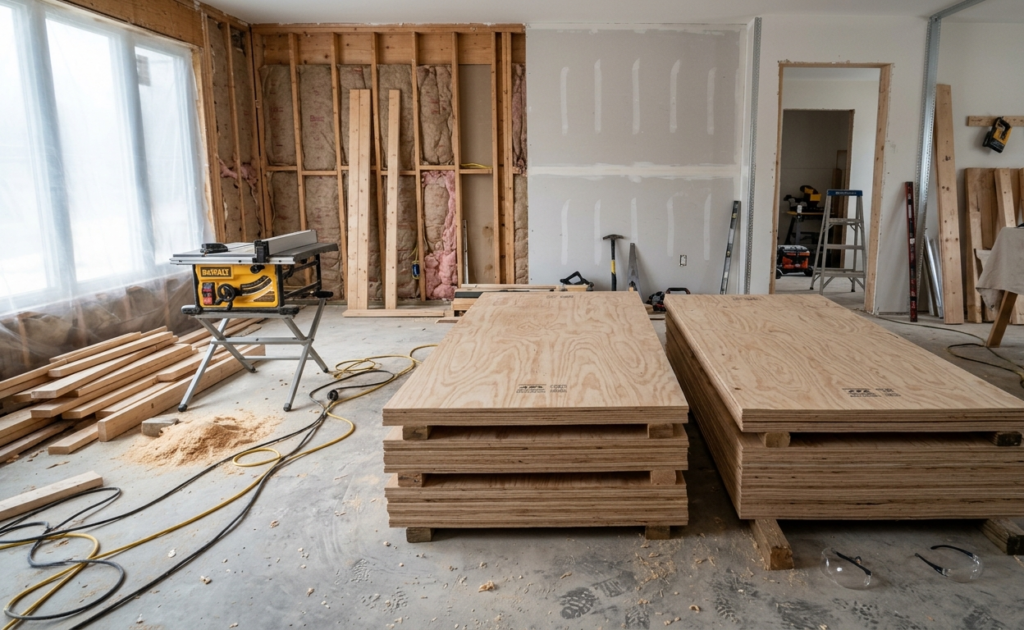
How can you identify good-quality plywood?
To identify good-quality plywood, inspect the sheet’s markings, edges, exposed core, surface condition and visible glue-line defects before accepting delivery. Confirm that the grade and thickness match the approved specification, and check the manufacturer’s documentation. No single test, including weight, tapping or appearance, can reliably establish plywood quality on its own.
When plywood arrives at your home interior site, this inspection matters. Once the sheets have been cut into wardrobe panels, kitchen cabinets or storage units, some defects become harder to identify and may already be built into the furniture.
You do not need to be a carpenter to perform a useful first inspection. You need a checklist, the approved material specification and enough time to examine the sheets before work begins.
1. Check the plywood markings before anything else
Start with the manufacturer’s markings and product documentation. Do not rely only on what the supplier or contractor calls the material.
Look for the following details:
- Manufacturer or brand: Confirm that the product comes from the approved manufacturer.
- Grade and intended use: Check that the supplied grade matches the specification for the intended application.
- Thickness: Verify that the nominal thickness is what was approved.
- Applicable standard: Check the relevant Indian Standard marking or certification details, where applicable, and verify them against the manufacturer’s documentation.
- Batch or traceability information: Retain the packaging, invoice or other information that identifies the supplied product.
For example, plywood specified for a moisture-prone application should not be accepted merely because the delivery note says “waterproof plywood.” The actual grade, intended use and manufacturer’s declared performance need to match the project requirements.
What do BWR, BWP and MR mean?
These terms describe different plywood categories or moisture-resistance claims.
Term | What to understand |
MR | Moisture-resistant plywood intended for appropriate interior applications; it is not waterproof. |
BWR | Boiling Water Resistant plywood, with performance governed by the applicable specification. |
BWP | Boiling Water Proof plywood terminology commonly used for higher water-resistance applications; verify the actual product standard and documentation. |
These labels are not substitutes for checking the actual product specification. Nor does a water-resistance category tell you everything about the sheet’s core quality, surface finish or structural suitability.
Site rule: If the delivered grade differs from the approved specification, stop and clarify the discrepancy before cutting the material.
2. Inspect the plywood edges and exposed core
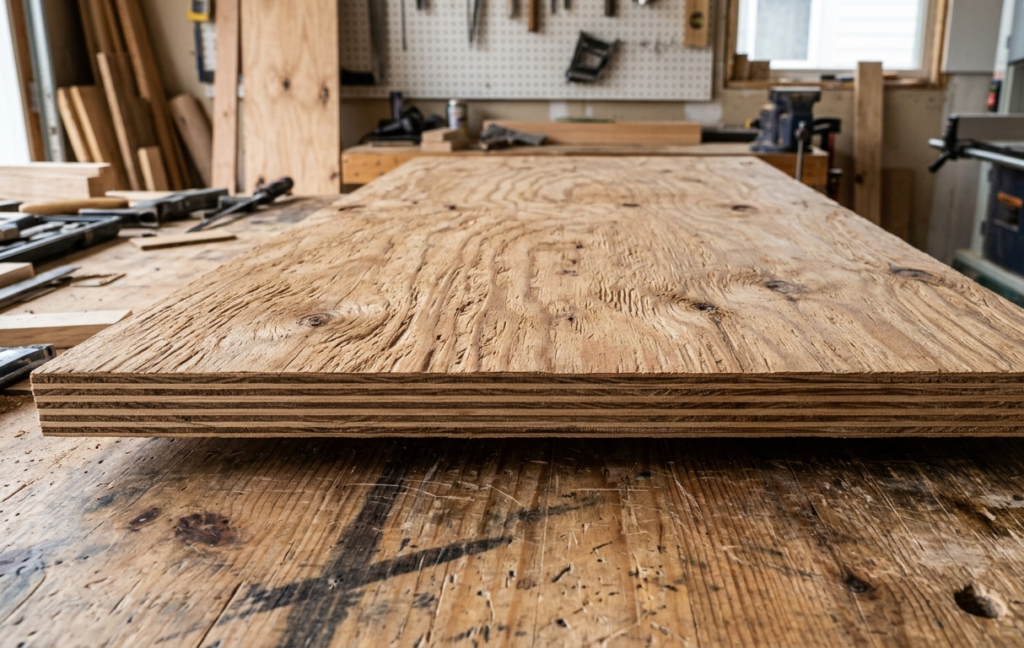
The exposed edge is one of the most useful places to look because it gives you a view of the veneer layers inside the sheet.
Examine several sheets, not just the top one.
What should you look for?
Consistent layers: The veneers should appear reasonably uniform, without obvious large gaps or missing sections.
Visible core gaps: Large voids, open cavities or poorly formed areas in the exposed core deserve closer inspection.
Layer separation: Look for veneers that appear to be separating or lifting away from adjacent layers.
Obvious damage: Crushed corners, chipped edges and damaged sections should be documented before the sheet is accepted.
Uneven construction: Significant inconsistencies between sheets may justify asking the supplier for clarification.
Not every variation visible at an edge automatically makes a sheet defective. Plywood construction varies by product and grade. The concern is whether a defect falls outside the product specification or affects the intended application.
Why does the core matter?
Consider a wardrobe shelf that will carry folded clothes or a cabinet panel that needs reliable fixings. Large internal voids or poor bonding can affect performance in ways that a decorative laminate on the outside will not reveal.
A neat-looking surface cannot compensate for a defective core.
3. Check the surface for visible defects
Place the sheet where you can see its surface clearly. Inspect it in good light, preferably before other sheets are stacked on top.
Look for:
- Deep cracks or splits.
- Blisters or raised areas.
- Loose or lifting veneer.
- Obvious surface delamination.
- Large patches or repairs that appear inconsistent with the approved product.
- Severe warping or damage that could affect cutting and installation.
- Water staining or signs that the sheet may have been stored improperly.
Some surface patches and natural variations may be normal for a particular grade. A sheet intended to receive a concealed finish has different appearance requirements from one intended for a visible veneer finish.
The correct question is not whether every sheet looks identical. It is whether the sheet’s condition is acceptable for the specified grade and final use.
If the plywood is intended for veneer or another finish that depends on surface quality, make the required face-grade and finish expectations clear before delivery.
4. Inspect the glue lines and look for delamination
Plywood is made by bonding veneer layers together. The quality of that bonding is important, but a quick visual inspection cannot fully establish adhesive performance.
Look at the exposed edges for obvious separation between layers. Check the faces for blisters, lifted veneer or areas where the layers appear to be coming apart.
What is a glue-line defect?
A glue-line defect occurs when the bond between layers does not perform as required. Visible separation can be a warning sign, although not every adhesive defect is visible from the outside.
If you notice suspected delamination, photograph the affected area and ask the supplier or manufacturer to assess the sheet.
Should you perform a water or boiling test on site?
Do not treat an improvised water-soaking or boiling test as a reliable homeowner quality test. Such tests require defined procedures and appropriate interpretation to establish whether a product meets a particular standard.
Likewise, pouring water over a sheet does not establish its overall quality or prove that it is suitable for every moisture-prone application.
For a disputed delivery, use the product documentation and, where necessary, a qualified inspection or appropriate laboratory testing.
5. Verify thickness instead of trusting the label
Plywood thickness matters because it affects how the board fits into the furniture design and how it performs under the expected load.
Check the thickness against the approved drawing or specification. If the project calls for a particular nominal thickness, do not assume that a visual estimate is sufficient.
A suitable measuring tool can help you check the sheet at several points. Record any meaningful discrepancy and ask the supplier to confirm whether it falls within the product’s permitted tolerances.
Keep in mind that nominal thickness and actual measured thickness are not necessarily identical in every product. Acceptance should follow the applicable specification and permitted tolerances, not an arbitrary rule applied to every board.
Why does thickness matter in furniture?
The plywood used for a wardrobe’s sides may have different requirements from a drawer base or a cabinet back. The right thickness depends on the panel’s function, dimensions, support, load and construction.
Thicker plywood is not automatically better plywood. A thicker sheet with poor bonding or an unsuitable grade can still be the wrong material for the job.
6. Is heavier plywood always better?
No. Weight alone is not a dependable plywood quality test.
The weight of a sheet can vary with wood species, density, moisture content, veneer composition, thickness and manufacturing characteristics. A heavier sheet is not necessarily stronger, better bonded or more suitable for your project.
You can compare sheets of the same product and specification if something looks unusual, but use the comparison as a reason to investigate, not as proof of quality.
The same applies to tapping a sheet and listening for a hollow sound. Differences in sound may prompt further inspection, but tapping cannot reliably establish the grade, adhesive performance or internal condition of every sheet.
Avoid choosing plywood through a single shortcut test. Use the approved specification, visible inspection, traceable product details and professional assessment where necessary.
7. Check for warping and storage damage
Plywood can be damaged before it reaches your site. Poor storage, moisture exposure, mishandling and unsupported stacking can affect its condition.
Look along the length and across the width of the sheet for obvious bending or distortion. Inspect the corners and faces for damage caused by transport or storage.
Ask these questions:
- Were the sheets stored flat and adequately supported?
- Are the edges damaged?
- Is there visible moisture staining?
- Do any sheets show substantial distortion?
- Are the sheets protected from rain and direct exposure to site moisture?
Some sheets may show minor variation that is acceptable for the specified product. The important issue is whether the condition will interfere with accurate cutting, joinery, finishing or installation.
Store accepted plywood according to the manufacturer’s recommendations. Do not leave it exposed to rain or assume that a moisture-resistant grade can be stored carelessly.
8. Inspect the delivery before cutting begins
A practical plywood inspection checklist is most useful when it becomes part of the site delivery process.
Use this checklist before the carpenter starts cutting the sheets.
- Confirm the brand and product specification against the approved material list.
- Check the grade and intended application.
- Verify the nominal thickness.
- Inspect exposed edges for obvious core gaps and layer separation.
- Inspect the faces for blisters, cracks, lifting veneer and major damage.
- Check for visible delamination.
- Look for substantial warping or distortion.
- Check for signs of poor storage or moisture damage.
- Photograph defects and identify the affected sheets.
- Record discrepancies against the delivery note or approved specification.
- Retain invoices, packaging and product documentation.
- Obtain clarification or replacement approval before using disputed sheets.
Inspecting only one sheet is not enough to establish that an entire delivery is consistent. Check multiple sheets, particularly where the delivery contains different batches, grades or thicknesses.
If the material does not match the approved specification, do not let it disappear into finished cabinetry before the discrepancy is resolved.
9. How should plywood quality be checked for wardrobes and kitchens?
The same plywood grade is not automatically appropriate for every part of a home.
For a wardrobe, pay particular attention to the intended structural use, shelf spans, fixings, finish and the condition of the wall behind the cabinet.
For kitchen cabinetry, consider moisture exposure, proximity to plumbing, edge protection and the manufacturer’s intended-use guidance. No plywood grade removes the need to manage leaks and persistent dampness.
If you are deciding between plywood and MDF, our guide to Plywood vs MDF for Home Interiors explains how the materials differ and why the application matters.
For a wardrobe project, material inspection should also be considered alongside the internal layout, board thickness, shutters and hardware. Our Custom Wardrobe Design for Indian Homes guide provides the next step for planning those decisions together.
10. What a good site inspection cannot tell you
A visual inspection is a useful first filter. It is not a substitute for product certification, laboratory testing or a qualified assessment when performance is disputed.
You may identify visible damage, inconsistent markings, open core gaps or signs of delamination. You cannot reliably determine every property of a plywood sheet by looking at it.
In particular, appearance alone cannot prove:
- The full bonding performance of the adhesive.
- Compliance with a specific product standard.
- The precise moisture-resistance performance.
- The suitability of the board for every load-bearing application.
- The absence of all internal defects.
When a supplier makes a technical claim, request supporting product documentation. If the material is critical to the project or the delivery is disputed, ask for an appropriate professional assessment.
This approach is more reliable than relying on a salesperson’s assurance or an informal test that has no defined acceptance criteria.
Final advice from Decore Designz Studio
Good interior execution begins before the material is cut. A sheet that arrives with the wrong specification, visible damage or questionable construction should be checked before it becomes part of a finished wardrobe, kitchen or storage unit.
Decore Designz Studio approaches material selection as part of the wider design and execution process. The objective is to specify suitable materials for the job, verify what arrives on site and pay attention to the details that affect the finished result.
If you are planning complete home interiors, explore our custom wardrobe design guideand interior design services. You can contact Decore Designz Studio to discuss your requirements and request a personalised quotation.
Frequently Asked Questions
How can I identify good-quality plywood at a site?
Check the product markings, grade, thickness, exposed core, surface condition, glue-line appearance and signs of storage damage. Compare the delivered sheets with the approved specification. No single visual or physical shortcut can establish every aspect of plywood quality.
How do I check plywood quality before buying?
Ask for the exact product specification and inspect representative sheets before approving the purchase. Confirm the manufacturer, intended grade, thickness and relevant documentation. If the material is for a critical application, seek suitable technical verification.
Can I check plywood quality by tapping it?
Tapping may reveal differences in sound, but it cannot reliably prove the sheet’s quality or detect every internal defect. Use it only as a preliminary observation, not as an acceptance test.
Is heavier plywood better?
Not necessarily. Weight varies with density, species, moisture content, thickness and construction. Check the product specification and visible condition instead of judging quality by weight alone.
How can I identify plywood with a poor core?
Inspect exposed edges for obvious voids, uneven layers, damaged veneers and visible separation. These are warning signs, but a visual inspection cannot establish every aspect of internal construction or bonding.
Does waterproof plywood mean the sheet cannot be damaged by water?
No. Water-resistance classifications describe performance under specified conditions. Prolonged exposure, poor storage, damaged edges or unsuitable installation can still cause problems.
Which plywood grade is best for home interiors?
There is no single grade that is best for every component. The appropriate grade depends on the application, expected moisture exposure, structural requirements, product specification and intended finish.