

Wardrobes with Sliding Doors: A Practical Bedroom Design Guide
Wardrobes with sliding doors can be an excellent choice for bedrooms where floor space, storage and visual simplicity all matter. Unlike hinged shutters, sliding doors move along a track, so they do not need additional opening space in front of the wardrobe.
But choosing a sliding wardrobe should not be based only on how modern it looks. The wardrobe width, internal layout, door configuration, hardware, depth and the way you move around the bedroom all need to work together.
At Decore Designz, we approach wardrobes as part of the bedroom rather than as a separate box of furniture. The storage has to work for the person using it every day.
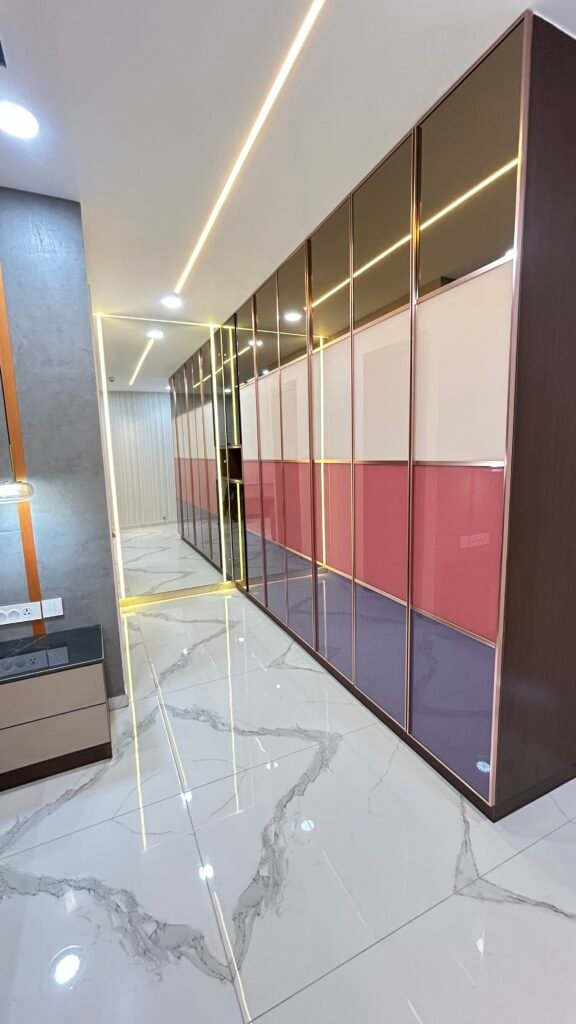
Why Choose Wardrobes with Sliding Doors?
The biggest practical advantage of wardrobes with sliding doors is the way they use the space in front of the wardrobe.
A hinged wardrobe needs clearance for its shutters to open. In a smaller bedroom, that opening movement can interfere with the bed, bedside tables, dressing area or walking path.
Sliding shutters stay within the wardrobe’s footprint.
This can make them useful for:
- Smaller bedrooms
- Bedrooms with narrow circulation areas
- Full-width wardrobes
- Long wardrobes
- Bedrooms where the bed is relatively close to the storage
- Modern interiors where a cleaner front is preferred
There is a trade-off, though.
When one sliding shutter is moved, another section may still remain covered. A hinged wardrobe can provide wider access to the entire cabinet when its doors are opened.
So there is no universal answer to whether sliding or hinged wardrobes are better. The room and the way you use the storage should decide.
Wardrobes with Sliding Doors and Drawers: Plan the Inside First
The outside of a wardrobe gets most of the attention.
The inside is what you actually use.
Before deciding on the shutter finish, think about what needs to go inside.
A practical wardrobe may need:
- Hanging sections for shirts, dresses or longer garments
- Drawers for everyday clothing and smaller items
- Adjustable shelves for folded clothes
- Accessory storage
- Shoe storage
- Upper storage for seasonal items
- Separate sections for different family members
- Dedicated space for bags or frequently used belongings
Wardrobes with sliding doors and drawers need slightly more careful planning because the internal layout should work with the shutter positions.
For example, if the wardrobe has three sliding shutters, think about which sections are accessed most often. Everyday items should not be placed in the least convenient section simply because there was space available there.
Good storage is not about filling every centimetre.
It is about making the right things easy to reach.
Sliding vs Hinged Wardrobes: What Is the Real Difference?
The decision becomes easier when you look at everyday use rather than appearance.
| Feature | Sliding Wardrobe | Hinged Wardrobe |
|---|---|---|
| Opening space | Minimal | Requires clear space |
| Access | Usually one section at a time | Wider access when opened |
| Small bedrooms | Often useful | Needs careful clearance |
| Long wardrobes | Works well with suitable hardware | Can require many shutters |
| Internal access | Depends on shutter position | Generally straightforward |
| Visual appearance | Clean and continuous | More segmented |
| Hardware | Track system is important | Hinges are important |
Neither system is automatically better.
If the bedroom has limited circulation space, sliding doors may solve a genuine planning problem.
If complete access to every section is more important, hinged shutters may make more sense.
The right decision comes from the room, not the trend.
How Deep Should a Sliding Wardrobe Be?
Wardrobe depth should be decided according to what the storage needs to hold and how much room the bedroom can comfortably spare.
A commonly used wardrobe depth may work well for hanging clothes, but the exact requirement can change depending on the internal fittings, shutter system and type of clothing being stored.
This is particularly important when someone searches for a wardrobe with sliding doors at around 50 cm depth.
Reducing depth may save floor space, but it can also affect hanging capacity and internal usability.
Instead of choosing a depth from a standard number alone, check:
- Available bedroom width
- Required hanging space
- Shutter and track requirements
- Internal accessories
- Bed-to-wardrobe clearance
- Walking space
- Whether the wardrobe is full height
A wardrobe that is slightly shallower but well planned can work better than a deeper wardrobe that makes the bedroom uncomfortable.
How Deep Should a Sliding Wardrobe Be?
Once the layout is correct, the shutter finish becomes a design decision.
White Sliding Wardrobes
Wardrobes with sliding doors in white can make a bedroom feel visually lighter and more continuous.
They work particularly well with neutral bedrooms, lighter flooring and simple wall treatments.
However, a completely white wardrobe is not automatically the best choice for every room. The finish should relate to the rest of the bedroom.
Black Sliding Wardrobes
Black or darker sliding shutters can create a stronger visual element.
They can work well in contemporary bedrooms with warm wood, beige, grey or neutral finishes.
The key is balance.
A dark wardrobe can become visually heavy if the rest of the room is already dark.
Mirror Sliding Wardrobes
Mirrored sliding shutters can serve two purposes: wardrobe access and a dressing/mirror surface.
They can also reflect light and visually open up a smaller room.
But mirrors are not a substitute for good space planning. If the wardrobe is badly positioned, adding a mirror will not fix the underlying problem.
Glass, fluted finishes, veneer, laminate and painted surfaces are other possibilities depending on the desired appearance, durability and budget.
What Makes a Sliding Wardrobe Feel Premium?
A premium wardrobe is not necessarily the one with the most decorative finish.
The details that matter are often less visible.
Look at:
- Board quality and construction
- Shutter alignment
- Track quality
- Smooth movement
- Hardware durability
- Edge treatment
- Internal organisation
- Drawer operation
- Finish consistency
- Installation quality
At Decore Designz, material selection is considered according to how the furniture will actually be used. Plywood, MDF and other materials can each have appropriate applications depending on the construction, finish, expected load and location.
The same principle applies to hardware.
A beautiful shutter with poor-quality sliding hardware will become frustrating to use.
A Real Decore Designz Example: Why the Wardrobe Cannot Be Designed Alone
Decore Designz’s 1,800 sq.ft. modern residential project in Kokapet is a useful example of the broader approach we take to storage and furniture planning.
The project combines modern design with practical planning, bespoke furniture and smart technology rather than treating individual pieces of furniture as isolated elements.
The lesson applies directly to bedroom wardrobes: storage needs to work with the bed, furniture, movement, lighting and overall visual language of the room.
A wardrobe can look impressive on its own and still be the wrong choice if it makes the bedroom difficult to use.
Common Mistakes with Sliding Wardrobes
1. Choosing the doors before planning the storage
The shutter style is visible, but the internal layout determines whether the wardrobe is actually useful.
2. Ignoring the track
Sliding wardrobes depend heavily on the quality and installation of their track system.
3. Making the wardrobe too deep
More depth does not automatically mean better storage. It can reduce circulation and make some areas harder to access.
4. Forgetting what is used every day
Frequently used clothing should remain easy to reach.
5. Designing the wardrobe independently
The wardrobe should be considered alongside the bed, dressing unit, windows, doors, lighting and walking paths.
6. Choosing a finish because it looks good online
A finish should suit the bedroom’s natural light, colour palette, maintenance requirements and overall design.
How to Organize a Closet with Sliding Doors
Start with categories rather than shelves.
Separate your belongings into:
Daily use: keep these at comfortable hand height.
Hanging clothes: provide enough vertical space rather than compressing too many garments together.
Folded clothing: use shelves that are practical to reach.
Small items: drawers are generally more useful than deep shelves.
Seasonal items: place less frequently used belongings higher up.
Accessories: give them dedicated compartments where needed.
The best internal wardrobe layout is the one that matches the person’s actual habits.
There is no reason for every bedroom in a home to have exactly the same internal arrangement.
Are Sliding Wardrobes Right for Your Bedroom?
They can be, particularly when saving opening space is important or when you want a long, visually clean wardrobe.
But the decision should come after looking at the complete bedroom.
Measure the room.
Check the bed position.
Look at the walking path.
Decide what needs to be stored.
Then choose the shutter system, internal layout, material and finish.
That order usually produces a better result than starting with a wardrobe image from Pinterest and trying to make the room fit around it.
For a broader look at bedroom storage planning, see our Bedroom Wardrobe Planning guide. If you are comparing the financial side of a custom wardrobe, our Wardrobe Cost in Hyderabad guide explains the factors that change the final quotation.
If the wardrobe is part of a larger home project, Decore Designz also provides Interior Design Services in Hyderabad, including customised wardrobes and storage solutions.

Frequently Asked Questions
Yes. They can be particularly useful when the bedroom has limited floor space because the shutters do not swing into the room. However, internal access and hardware quality should be considered.
Neither is universally better. Sliding wardrobes reduce opening clearance, while hinged wardrobes usually provide wider access to the cabinet when opened. The bedroom layout and storage requirements should determine the choice.
Yes. Drawers can be incorporated into the internal wardrobe layout. Their position should be planned around the sliding shutter configuration and the items that need frequent access.
They can be useful when you want a full-length mirror and want the wardrobe to reflect more light. The mirror should still complement the bedroom rather than being used simply to make a small room appear larger.
They can be. The main advantage is that the shutters do not need additional opening clearance. The wardrobe’s depth, width and position still need to be planned carefully.
Sliding shutters move horizontally along a track system, allowing one shutter to pass behind or in front of another depending on the design. This removes the swing space required by hinged shutters.
Check the available wall width, wardrobe depth, floor and ceiling conditions, shutter alignment, track quality, internal storage layout and the clearance around the bed and other furniture.